

Spiritual
Chuck was raised in the Church of Christ and his family began attending the South Baton Rouge Church of Christ in 1975 when the congregation was founded. Chuck ( and his wife Leah) have served the South Baton Rouge Church of Christ congregation in various capacities over the years. Most recently serving as one of the “Elders” of the church family (Fall 2009 through Summer 2025).
Below are several resources that were helpful to either individual studies, bible class materials, or congregational discussions:
New Testament course
Introduction to New Testament History and Literature, Professor Dale Martin (Yale)

This course provides a historical study of the origins of Christianity by analyzing the literature of the earliest Christian movements in historical context, concentrating on the New Testament. Although theological themes will occupy much of our attention, the course does not attempt a theological appropriation of the New Testament as scripture. Rather, the importance of the New Testament and other early Christian documents as ancient literature and as sources for historical study will be emphasized. A central organizing theme of the course will focus on the differences within early Christianity (-ies). This course was recorded in Spring 2009.
Old Testament Courses
Shaye J.D. Cohen, a professor of Hebrew Literature and Philosophy at Harvard, has just released his second free course on iTunes. The first course was called The Hebrew Scriptures in Judaism & Christianity. The new one, simply titled The Hebrew Bible, “surveys the major books and ideas of the Hebrew Bible (also called the Old Testament) examining the historical context in which the texts emerged and were redacted. A major subtext of the course is the distinction between how the Bible was read by ancient interpreters (whose interpretations became the basis for many iconic literary and artistic works of Western Civilization) and how it is approached by modern bible scholarship.”
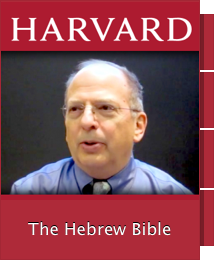
1. The Hebrew Bible: "Taught by Professor Shaye J.D. Cohen, this course surveys the major books and ideas of the Hebrew Bible (also called the Old Testament) examining the historical context in which the texts emerged and were redacted. A major subtext of the course is the distinction between how the Bible was read by ancient interpreters (whose interpretations became the basis for many iconic literary and artistic works of Western Civilization) and how it is approached by modern bible scholarship. James Kugel, former Harvard professor and author of the course’s textbook, contends that these ways of reading the Bible are mutually exclusive. Professor Cohen respectfully disagrees."
Course Materials:

2. The Hebrew Scriptures in Judaism & Christianity: "In 70CE the Romans destroyed the Temple in Jerusalem. Second Temple Judaism, whose worship consisted of animal sacrifice permitted by biblical command only at the Temple, would have to reinvent itself as Rabbinic Judaism. Contemporaneously, the authors of the New Testament Gospels were writing about the Jewish apocalyptic prophet whom they believed was the awaited messiah. For both the rabbis and the gospel writers, for both ancient Jews and ancient Christians, the central authoritative text was the Torah and the other books we now call the Hebrew Scriptures. This course surveys how the interpretation (and reinterpretation) of these books spawned two rival cultural systems, Judaism and Christianity.
The issues addressed are:
a) What are the truth claims of Judaism and Christianity?
b) In the first centuries of our era, how did Jewish biblical interpretation differ from Christian?
c) What differences resulted in "the parting of the ways" between Judaism and Christianity?
d) How does each culture deal with the biblical passages concerning: circumcision, the food laws, the Sabbath, Passover, the manifestations of the deity (e.g., Logos), the messiah, atonement/redemption, and the concept of Israel as the chosen of God?"
Course Materials:
Bible Class Study Materials
1) Baptism
3) Gospel of John – Continuing Education weekend for Elders and Ministers of SBRCC (pdf)
4) Elder Selection - Study Materials & Samples
5) History... Church History (pdf)
6) LGBTQ+: Some of the Passages and a few additional resources (pdf)

Early Middle Ages by Yale University
Major developments in the political, social, and religious history of Western Europe from the accession of Diocletian to the feudal transformation. Topics include the conversion of Europe to Christianity, the fall of the Roman Empire, the rise of Islam and the Arabs, the "Dark Ages," Charlemagne and the Carolingian renaissance, and the Viking and Hungarian invasions.
*Materials and courses provided on this page are not affiliated with Raymond James Financial Services, Inc.*